Well, it looks like I've managed to survive (most of) another Southern summer without melting and/or complaining incessantly. I think I was better than ever about resisting the urge to use the oven, dishwasher, and any other heat sources in the kitchen as freely as I do when temperatures are more moderate. That and a list of summer meal ideas (which I didn't actually consult much; merely making it was some sort of psychological boost) helped a lot. But having had a taste of cool mornings lately, I am more restless than ever to start using my oven for middle-of-the-day baking projects and slow-cooked meats; I have always intensely looked forward to fall for many reasons, and as I cook more the anticipation grows each year. Spring and summer certainly have their culinary delights, but for me, primarily a baker, the prospect of cooler weather leading up to the best of all holidays (Thanksgiving, closely followed of course by Christmas) is more tantalizing than anything.
I started making a top ten list in my head of the dishes I will be making as soon as it cools down. They are:
1. Pork vindaloo (from Best International Recipe; review here). My Indian repertoire currently consists of this stew and a delicious recipe for coconut milk-braised green beans, so I can't speak to authenticity or anything, but just as a stew it is fantastic.
2. Spiced carrot soup (adapted from Cafe Bouloud, as printed in CI's Restaurant Favorites at Home). I've rarely made a soup with such complex flavors--the finish with fresh carrot juice is brilliant--and the smell of the carrots braising in coconut milk and curry powder is out of this world. The original recipe calls for shrimp, and it does work well, but I often just make it plain and serve with a hearty, interesting salad and bread.
3. Spanish-style pork loin with sherry-raisin vinaigrette. This was a seriously good pork roast and I wrote about it here.
4. Chicken in a pot (much more elegantly known by its French name, poulet en cocotte). I tried this once last year out of BIR, and it was quite good, though it took much longer to finish than indicated and that always gets me flustered. It was still, as promised, a very low-fuss way of evenly cooking a whole chicken while keeping it moist, and it tasted very French and refined. And wintry.
5. Any big old cheesy pasta casserole that takes two hours to bake--any at all. Pastitsio in particular. (Another nice thing about cooler weather is that my motivation to exercise is ten times what it is in the summer, which is good because pastitsio will make even me feel compelled to schedule an extra few minutes into my next workout. And I am not a calorie-counter.)
6. Thai chicken soup (tom kha gai), also from BIR. The lemongrass, the coconut milk, the sweat-inducing spice from the chiles and curry paste...I could eat this stuff every day.
7. Sweet potatoes: baked, in soups, in pies, anything. There's a mashed sweet potatoes with vanilla recipe in Restaurant Favorites that I also need to try. Cream, vanilla, butter, and the best vegetable ever. How could that go wrong?
8. Chowder. Specifically corn (with generous amounts of bacon) and clam. I was fairly addicted to this clam chowder last year.
9. Simple, one-dish meat and potato meals you stick in the oven and forget about, like this one. That was a good recipe. Also, braised beef with polenta and crusty bread. Lucky you, the beef recipe is on Google Books here.
10. A hundred variations on grilled cheese and only one (the best) cream of tomato soup. CI's 30-minute tomato soup, to be exact. I've tried their standard (more time-consuming) soup, too, and I think it has nothing on the quick one. I must have made this soup 100 times last year and never got the slightest bit sick of it. Below is my adaptation of the recipe.
Cream of Tomato Soup
adapted from Cook's Illustrated, Best 30-Minute Recipe
3 (14.5 oz) cans diced tomatoes
3 c. Swanson low-sodium or homemade chicken broth, plus maybe a little more
2 bay leaves
2 Tbsp. butter
1 onion, minced
1 Tbsp. brown sugar
1 Tbsp. tomato paste
2 Tbsp. flour
1/3 c. heavy cream
2 tsp. dry sherry
1. Put the tomatoes one can at a time into a strainer set over a large bowl. Squeeze out as much juice as you can: ideally you'll get 2 cups after all the cans are strained. Add broth to equal 5 cups of liquid. Bring the broth /juice mixture with the bay leaves to a boil in a medium saucepan, then cover and keep warm.
2. Meanwhile, melt the butter in a large pot or Dutch oven over high heat. Add the drained tomatoes, onion, brown sugar, tomato paste, and 1/2 tsp. salt. Cook, stirring frequently, until the tomatoes look dry and are beginning to brown, 10-12 minutes. Stir in the flour and cook for 1 minute.
3. Slowly whisk or stir in the hot broth mixture. Bring to a simmer and cook for 5 minutes to blend flavors.
4. Remove the bay leaves, then puree the soup in batches in a blender. (With hot liquids it's best to remove the little plastic cap inside the lid, and cover the hole with a thickly folded dish towel under your hand.) Return pureed soup to the pot and stir in the cream and sherry. Bring it just to a simmer, then remove from heat, season with salt and cayenne pepper to taste, and serve. (Yield: 6 servings. If you want to make this a day or two ahead, don't add the cream and sherry until you reheat it before serving.)
Wednesday, August 31, 2011

Thursday, August 18, 2011
Black-eyed pea cakes: a belated review
A couple weeks ago I finally got around to making this delicious vegetarian take on black-eyed pea cakes from Restaurant Favorites at Home. This book is one installment in the Cook's Illustrated Best Recipe "series," if a line of cookbooks can be called such. Since I gather from fruitless Google searches that it is not widely reviewed online (probably because it was published in 2003, right around when blogs were gaining ground as a high school "fad," and further because it seems to have gone out of print since then), I want to try to review everything I make from it on this blog.
Since it was just two of us for lunch, I halved both components of this recipe (said to serve 6). I had tons of sauce leftover, and especially for lunch portions, 3 cakes each (which comes out to be the serving size) was a bit too much. I wouldn't call these dainty little things. Especially relevant for entertaining, you have the option of making the cakes ahead, up to the frying---ironically an overnight rest was deleted from the original restaurant recipe because of the challenges that planning ahead could pose for the home cook. I made the cakes the night before (which means you have to soak the black-eyed peas the night before that) and brought them most of the way to room temperature before frying, just to be safe. I wouldn't make the sauce ahead, as I thought the texture suffered quite a bit the next day(s). (Did I mention I had a lot left over?!)
My one major problem with the outcome was that while dipping them in the panko before frying, several of the cakes "crumbled" a bit, and a couple completely fell apart, making them un-fryable. But that was almost certainly due to the fact that I could not properly puree part of the beans (lacking a food processor), as the recipe tells you to do presumably to help them bind better. So I don't think that's a recipe problem: just be sure not to skip the puree.

The sauce was very quick and easy, and pretty tasty. There's something so restaurant-esque to me about making a sauce that begins with a bunch of chopped stuff on the stovetop and ends in a smooth puree in the blender... Anyway, for me this sauce wouldn't be spicy unless you added a good deal more Tabasco. (I would want to try it now with the chipotle Tabasco I opened up the other night, which I found fairly addictive.)
The only pictures I took of the leftover cakes (which I put back in the fridge until frying the next day) were terribly out of focus and not worth posting. Overall I'd give this recipe a 6/10. Perfectly decent flavor, not too fussy, and a nice option for a Southern vegetarian (rare combination!) lunch or main course.
Since it was just two of us for lunch, I halved both components of this recipe (said to serve 6). I had tons of sauce leftover, and especially for lunch portions, 3 cakes each (which comes out to be the serving size) was a bit too much. I wouldn't call these dainty little things. Especially relevant for entertaining, you have the option of making the cakes ahead, up to the frying---ironically an overnight rest was deleted from the original restaurant recipe because of the challenges that planning ahead could pose for the home cook. I made the cakes the night before (which means you have to soak the black-eyed peas the night before that) and brought them most of the way to room temperature before frying, just to be safe. I wouldn't make the sauce ahead, as I thought the texture suffered quite a bit the next day(s). (Did I mention I had a lot left over?!)
My one major problem with the outcome was that while dipping them in the panko before frying, several of the cakes "crumbled" a bit, and a couple completely fell apart, making them un-fryable. But that was almost certainly due to the fact that I could not properly puree part of the beans (lacking a food processor), as the recipe tells you to do presumably to help them bind better. So I don't think that's a recipe problem: just be sure not to skip the puree.

Sauce in the making: looks like Christmas!
The sauce was very quick and easy, and pretty tasty. There's something so restaurant-esque to me about making a sauce that begins with a bunch of chopped stuff on the stovetop and ends in a smooth puree in the blender... Anyway, for me this sauce wouldn't be spicy unless you added a good deal more Tabasco. (I would want to try it now with the chipotle Tabasco I opened up the other night, which I found fairly addictive.)
The only pictures I took of the leftover cakes (which I put back in the fridge until frying the next day) were terribly out of focus and not worth posting. Overall I'd give this recipe a 6/10. Perfectly decent flavor, not too fussy, and a nice option for a Southern vegetarian (rare combination!) lunch or main course.
Tuesday, August 16, 2011
Orzo salad with serrano ham and roasted peppers
We tried serrano ham for the first time in this dish a couple nights ago, which I made based on an intriguing Epicurious recipe. Apart from M's reasonable point that it seemed like more of a side salad than a main dish, we both enjoyed it a lot, and I found it plenty for a light supper. I didn't take a picture because the end result looked kind of like a mess after I mixed it all up; it would be much prettier as a layered salad perhaps. I was surprised at how creamy and flavorful the dressing was: I've never made one that started out with equal parts almonds and water, but it definitely works.
Spanish orzo salad
Yield: 2 main-dish or about 4 side servings
(You will have a fair amount of leftover dressing; you may have to puree it again with a little water to return it to the proper consistency after a couple days in the fridge, as I've just discovered.)
1 small, or 1/2 a large, shallot, chopped fine
1/2 tsp. sea salt
1/2 c. plus 2 Tbsp. blanched slivered almonds, toasted and cooled
1/2 c. water
1 Tbsp. sherry vinegar
3 Tbsp. extra-virgin olive oil
1 generous pinch piment d'espelette, or 1/4 tsp. hot sauce (like Tabasco)
1/8 tsp. fresh ground black pepper
4 oz. dry orzo, cooked al dente, then drained and tossed with a tsp. olive oil and spread out over a baking sheet to cool to room temp.
about half a 12 oz jar of piquillo, or regular red/yellow roasted peppers, rinsed and patted dry, then sliced thin
1 large slice serrano ham, sliced into ribbons
2 hard-boiled eggs, sliced into eighths
To make the dressing, combine the shallot, salt, 1/2 c. almonds, water, vinegar, oil, hot sauce or piment, and pepper in a blender; puree til completely smooth. Taste and season if necessary.
Scrape the cooled orzo into a bowl and combine with a couple spoonfuls of dressing. At this point you could assemble the salad in layers, or just mix the orzo with the ham, peppers, and reserved 2 Tbsp. almonds, then arrange the sliced eggs on top of each serving with another sprinkle of the piment d'espelette and/or drizzle of dressing.
Spanish orzo salad
Yield: 2 main-dish or about 4 side servings
(You will have a fair amount of leftover dressing; you may have to puree it again with a little water to return it to the proper consistency after a couple days in the fridge, as I've just discovered.)
1 small, or 1/2 a large, shallot, chopped fine
1/2 tsp. sea salt
1/2 c. plus 2 Tbsp. blanched slivered almonds, toasted and cooled
1/2 c. water
1 Tbsp. sherry vinegar
3 Tbsp. extra-virgin olive oil
1 generous pinch piment d'espelette, or 1/4 tsp. hot sauce (like Tabasco)
1/8 tsp. fresh ground black pepper
4 oz. dry orzo, cooked al dente, then drained and tossed with a tsp. olive oil and spread out over a baking sheet to cool to room temp.
about half a 12 oz jar of piquillo, or regular red/yellow roasted peppers, rinsed and patted dry, then sliced thin
1 large slice serrano ham, sliced into ribbons
2 hard-boiled eggs, sliced into eighths
To make the dressing, combine the shallot, salt, 1/2 c. almonds, water, vinegar, oil, hot sauce or piment, and pepper in a blender; puree til completely smooth. Taste and season if necessary.
Scrape the cooled orzo into a bowl and combine with a couple spoonfuls of dressing. At this point you could assemble the salad in layers, or just mix the orzo with the ham, peppers, and reserved 2 Tbsp. almonds, then arrange the sliced eggs on top of each serving with another sprinkle of the piment d'espelette and/or drizzle of dressing.
Monday, August 8, 2011
Lemongrass-lime leaf soda
I love the idea of making "custom" sodas like this (which has 8 grams of sugar per serving as opposed to about 35-40 in a canned drink), because I feel like I should at least avoid sodas loaded with sugar on top of my regular dessert habit...This drink doesn't taste like a compromise at all. It's extremely flavorful and perfectly sweet, and if you can't find lime leaves, just double the amount of lime zest.
Lemongrass-lime leaf soda
Makes 12
from Bon Appetit, May 2011
Lemongrass-infused mixture:
1/4 c. lemon zest (from about 6 lemons)
1/4 c. lime zest (from about 8 limes)
20 kaffir lime leaves
2 stalks lemongrass, roughly chopped (you usually have to peel off the tough outer layers to be able to chop it easily)
2 cups water
Combine all ingredients in a saucepan. Bring to a boil, then reduce heat and simmer about 5 minutes. Strain into a jar and let cool, then chill.
Simple syrup:
1/2 c. sugar
1/2 c. water
Heat in a saucepan over medium heat til sugar is dissolved, stirring occasionally. Pour into a jar and let cool, then cover and store in the fridge up to 1 month.
To assemble the drinks:
Fill a 12-oz glass with ice; add 2 Tbsp of the lemongrass mixture and 1 Tbsp of the simple syrup, then top off with about 1/2 cup of seltzer/soda water. Stir to combine and enjoy.
Lemongrass-lime leaf soda
Makes 12
from Bon Appetit, May 2011
Lemongrass-infused mixture:
1/4 c. lemon zest (from about 6 lemons)
1/4 c. lime zest (from about 8 limes)
20 kaffir lime leaves
2 stalks lemongrass, roughly chopped (you usually have to peel off the tough outer layers to be able to chop it easily)
2 cups water
Combine all ingredients in a saucepan. Bring to a boil, then reduce heat and simmer about 5 minutes. Strain into a jar and let cool, then chill.
Simple syrup:
1/2 c. sugar
1/2 c. water
Heat in a saucepan over medium heat til sugar is dissolved, stirring occasionally. Pour into a jar and let cool, then cover and store in the fridge up to 1 month.
To assemble the drinks:
Fill a 12-oz glass with ice; add 2 Tbsp of the lemongrass mixture and 1 Tbsp of the simple syrup, then top off with about 1/2 cup of seltzer/soda water. Stir to combine and enjoy.
Wednesday, July 27, 2011
*sigh*
Naturally, right after I mention my love-hate relationship with food blogs, I discover this. And within that, this. Hostess cupcakes were my #1 junk food obsession as a child. Twinkies and Moon Pies I never understood: the thought of them still makes me gag. And I'd probably gag upon tasting a Hostess cupcake today, but in my memory they are immaculately sweet and gooey. I will be making this recipe as soon as... I can convince myself to buy marshmallow creme. Hm, I forgot there was marshmallow in the middle. Blech. Anyway, might as well go enjoy this newest expansion of Cook's Illustrated before they start charging $29.95 for it. ;)
"Focaccia? She's not here right now."
Today I came across this old (1987) NYT article in which the author recounts responses she got, like the one in this post's title, when phoning restaurants across the city in search of focaccia, which had just started to "make a dent" at the time. Funny to see her accurate prophecy about an increase in popularity. It reminded me I haven't yet made a single focaccia all summer, which should change this weekend.
This was bagel day, though, and thanks to a new baking sheet (actually old, just new to this purpose) that all but burned the bottoms of one batch meant to be given away, tomorrow will probably also be bagel day. Oh well. One of my experiments for this round was determining how many pans of bagel dough I can fit into my refrigerator on a normal day. Not really, but I did find that with some finagling I can do three batches at a time instead of just two.

The pan at the top is filled with egg bagels, which M had requested a while ago and I finally researched and made. Brown Eyed Baker, which is quickly moving to the top of my least obnoxious food blogs list*, has several posts on bagels, and the author actually had private correspondence with Peter Reinhart (I am starstruck) to find out what changes to make to his basic recipe in order to get egg bagels. Unlike BEB I used the Artisan Breads Everyday recipe I always do, but followed the same instructions for adding egg yolks and decreasing water. I had half of one while I was slicing and packaging the whole lot, mostly because I discovered too late that these were much softer and more fragile than regular bagels and so tore the first one apart while slicing. It didn't rock my world, but we'll see what the egg bagel connoisseur here thinks. That was really the only experiment; the other two batches are the same kind I've been making.
In other news, I think I found my heirloom tomato supplier for the rest of the summer at the Suwanee Farmers Market yesterday. I've never seen so many varieties of beautiful tomatoes. I only brought home a couple different kinds: the yellow brandywine I had in a salad was very nice, and I think Cherokee chocolate is the kind I found last summer and loved, so I also have a pound of those for tonight's dinner. Fresh tomatoes may just be worth suffering through a GA summer for. And that may be the most awkward sentence I have ever crafted.
* About food blogs and why I find them obnoxious: it's mostly because I can't simply handle them in their ubiquity and variety. Being as ADD as I am, if I read food blogs whenever I wanted I would a) never use the cookbooks I own, b) never use the cookbooks I check out from the library, c) never use the food I already bought for my "meal plan" (loosely so-called) that I meticulously map out with all sorts of frugal intentions at the beginning of the week, etc., etc. In short they are distracting and counterproductive for me because of my weakness. And I find that obnoxious. :)
This was bagel day, though, and thanks to a new baking sheet (actually old, just new to this purpose) that all but burned the bottoms of one batch meant to be given away, tomorrow will probably also be bagel day. Oh well. One of my experiments for this round was determining how many pans of bagel dough I can fit into my refrigerator on a normal day. Not really, but I did find that with some finagling I can do three batches at a time instead of just two.

The pan at the top is filled with egg bagels, which M had requested a while ago and I finally researched and made. Brown Eyed Baker, which is quickly moving to the top of my least obnoxious food blogs list*, has several posts on bagels, and the author actually had private correspondence with Peter Reinhart (I am starstruck) to find out what changes to make to his basic recipe in order to get egg bagels. Unlike BEB I used the Artisan Breads Everyday recipe I always do, but followed the same instructions for adding egg yolks and decreasing water. I had half of one while I was slicing and packaging the whole lot, mostly because I discovered too late that these were much softer and more fragile than regular bagels and so tore the first one apart while slicing. It didn't rock my world, but we'll see what the egg bagel connoisseur here thinks. That was really the only experiment; the other two batches are the same kind I've been making.
In other news, I think I found my heirloom tomato supplier for the rest of the summer at the Suwanee Farmers Market yesterday. I've never seen so many varieties of beautiful tomatoes. I only brought home a couple different kinds: the yellow brandywine I had in a salad was very nice, and I think Cherokee chocolate is the kind I found last summer and loved, so I also have a pound of those for tonight's dinner. Fresh tomatoes may just be worth suffering through a GA summer for. And that may be the most awkward sentence I have ever crafted.
* About food blogs and why I find them obnoxious: it's mostly because I can't simply handle them in their ubiquity and variety. Being as ADD as I am, if I read food blogs whenever I wanted I would a) never use the cookbooks I own, b) never use the cookbooks I check out from the library, c) never use the food I already bought for my "meal plan" (loosely so-called) that I meticulously map out with all sorts of frugal intentions at the beginning of the week, etc., etc. In short they are distracting and counterproductive for me because of my weakness. And I find that obnoxious. :)
Tuesday, July 19, 2011
of beef and other things
Well, despite meticulous preparations, my little steak dinner Saturday night did not go off without a hitch. I (probably irrationally) blame Publix for the rotten potato, and my own sorry self for the slightly overcooked filets...at least they were still delicious and tender, and overall the meal went acceptably according to plan. I ended up using almost all Manchego for the gougères, which turned out delicious. I took a cue at the last minute from my little Julia Child compendium and made a riff on her baked tomatoes provençal, filling them with smoked trout and topping them with garlicky bread crumbs.

The baked potato fans could have used a little practice first, and I have extra gorgonzola topping still in the fridge waiting to be used on a non-rotten potato...one of those between the two of us turned out to be more than enough, though. They were tasty. I also turned to Julia Child for a new spinach preparation: you sauté the spinach just til wilted and then let it "braise" for 5 minutes or so in a little cream, which never binds to it as in (what I know as) creamed spinach. So it turns out lighter but still tastes like cream, which is never a bad thing!
High on the list of the meals that tempt me away from my resolution not to use the oven on ~95 degree days are red enchiladas. I use the beef variation of the recipe in Best International Recipe and few things taste better to me with a dollop of sour cream and a squeeze of lime juice. Unable to help myself, I made a batch for lunch today---yes, in the middle of the day, using a 400 degree oven for half an hour. But the smell of the beef cooking in the sauce alone makes it worthwhile. I love that these, unlike other enchiladas I've tried, do not totally fall apart upon reheating, and leftovers actually taste at least as good as fresh. As you can see in the picture, they also lack that greasy sheen characteristic of many Mexican restaurant enchiladas... as far as enchiladas go, I consider these quite healthy: tomato sauce, lean steak, calcium-rich cheese, and whole grain corn tortillas!


first course
The baked potato fans could have used a little practice first, and I have extra gorgonzola topping still in the fridge waiting to be used on a non-rotten potato...one of those between the two of us turned out to be more than enough, though. They were tasty. I also turned to Julia Child for a new spinach preparation: you sauté the spinach just til wilted and then let it "braise" for 5 minutes or so in a little cream, which never binds to it as in (what I know as) creamed spinach. So it turns out lighter but still tastes like cream, which is never a bad thing!
High on the list of the meals that tempt me away from my resolution not to use the oven on ~95 degree days are red enchiladas. I use the beef variation of the recipe in Best International Recipe and few things taste better to me with a dollop of sour cream and a squeeze of lime juice. Unable to help myself, I made a batch for lunch today---yes, in the middle of the day, using a 400 degree oven for half an hour. But the smell of the beef cooking in the sauce alone makes it worthwhile. I love that these, unlike other enchiladas I've tried, do not totally fall apart upon reheating, and leftovers actually taste at least as good as fresh. As you can see in the picture, they also lack that greasy sheen characteristic of many Mexican restaurant enchiladas... as far as enchiladas go, I consider these quite healthy: tomato sauce, lean steak, calcium-rich cheese, and whole grain corn tortillas!

Wednesday, July 13, 2011
R.I.P. Sourdough seed culture #2: 7/5/2011-7/12/2011
Well, I spoke too soon. I'm going to do some serious web-scouring research before undertaking this again, because sourdough is maybe not as straightforward as I thought. I was dissuaded from moving to phase 3 on Thursday night after realizing that the description it had to match was "active and bubbling" (whereas I only really had bubbly starter), and by means of Youtube I confirmed that active starter actually bubbles up and moves continually like a little swamp in a bowl. Alas, that was the last I saw of any bubbly action, because for the past four days I've been nursing a very flat and bubble-less mess, pinching my nose through the awful smell (it went from pleasantly acidic to filling much of the house with a sewage-like odor), to no avail. Once I can get that smell out of my memory (and fully out of the kitchen), perhaps I will try again, with the pineapple juice this time and a very clear idea of what kind of "activity" I need to be looking for.
On a happier note, M's birthday is this weekend, and I gave him a choice of "menus" for a nice meal. He chose the least adventurous (i.e. no cuts of meat I've never even purchased before), perhaps wisely. :P I guess the unifying theme would be French-inspired? For apps, gougères (Michael Ruhlman's ratio); first course, a summer tomato salad probably with green goddess dressing; filet mignon with a red wine pan sauce, sides of blue cheese baked potato fans (they sound a little kitschy but it's an ATK recipe and looks worth trying) and braised leeks (ATK). For dessert he just wanted a classic yellow birthday cake (Smitten Kitchen's, I've used this for cupcakes before and it was excellent) with CI's foolproof chocolate frosting and perhaps also vanilla ice cream. Since cupcakes apparently aren't manly enough, I will halve the cake recipe and slice one layer horizontally so it's still a layer cake, but more reasonable for two people. It remains to be seen whether I can pull all this off at once: I have at least made the pâte à choux, steak, and leeks before. I've also made a few cakes in my day, so no problems there as long as we don't have any unreasonable expectations as to the appearance... Should be fun.
On a happier note, M's birthday is this weekend, and I gave him a choice of "menus" for a nice meal. He chose the least adventurous (i.e. no cuts of meat I've never even purchased before), perhaps wisely. :P I guess the unifying theme would be French-inspired? For apps, gougères (Michael Ruhlman's ratio); first course, a summer tomato salad probably with green goddess dressing; filet mignon with a red wine pan sauce, sides of blue cheese baked potato fans (they sound a little kitschy but it's an ATK recipe and looks worth trying) and braised leeks (ATK). For dessert he just wanted a classic yellow birthday cake (Smitten Kitchen's, I've used this for cupcakes before and it was excellent) with CI's foolproof chocolate frosting and perhaps also vanilla ice cream. Since cupcakes apparently aren't manly enough, I will halve the cake recipe and slice one layer horizontally so it's still a layer cake, but more reasonable for two people. It remains to be seen whether I can pull all this off at once: I have at least made the pâte à choux, steak, and leeks before. I've also made a few cakes in my day, so no problems there as long as we don't have any unreasonable expectations as to the appearance... Should be fun.
Monday, July 11, 2011
Chocolate-coconut sherbert
I've never been entirely sure what sherbe(r)t* is, and David Lebovitz can't even put his finger on it, but I don't care: I can't believe how good this stuff turned out. It's the first ice cream-type thing I've made that has a flawless texture. It's like frozen mousse. I used my stand-by, Trader Joe's 72% dark chocolate, and I might be afraid if I used semi-sweet that the ice cream would be too sweet. But the only real downside with this dessert is the danger of having it within easy reach in my freezer. And lucky you, this recipe is available online.
* I just discovered that sherbe(r)t is usually spelled without the second 'r.' I've always pronounced it as I spell it, sherbert. But "sherbet" is how DL spells it throughout his book. Weird.
* I just discovered that sherbe(r)t is usually spelled without the second 'r.' I've always pronounced it as I spell it, sherbert. But "sherbet" is how DL spells it throughout his book. Weird.
Chicken stock: or, how to fool yourself into thinking summer is over
On this horrifically hot and humid day I am inside enjoying the evocative, cool-weather smell of chicken stock. I finally gathered enough chicken bones in the freezer to make some, and just in time. I really hate buying those little boxes of broth (except during holiday sales when I have coupons), knowing that it costs pennies and part of an afternoon to make a few perfectly serviceable quarts to keep in the freezer. Here is my usual recipe, adapted from Gourmet.
NOTES: I hardly ever have celery or thyme on hand, so take it from me that this stock is still very good without those things. I mostly gather the bones and rib sections from bone-in split chicken breasts, which are so cheap and easy to carve, and keep them in a bag in the freezer til I have enough. The biggest rookie mistake with stock, I think, is one I actually committed today (while I was drafting this post and doing laundry and making sherbert, which see below): letting it simmer too quickly, or worse, boil. You don't have to be super attentive with stock, but you do want to check now and then, especially at the beginning (when you have to be around to skim the foam anyway), that the liquid is just barely at a simmer (180 degrees is ideal). Otherwise, it will boil down too quickly, becoming concentrated and not yielding the amount you were trying to get. Probably it affects the flavor is some way too, but I don't know, I'm no connoisseur. Obviously. Due to this mistake it looks like I only got about two quarts today, quite a bit less than usual. Oh well.
Rich Chicken Stock
adapted from Gourmet magazine
3-3 1/2 lbs. raw chicken bones and/or wings
2 celery ribs, halved
2 carrots, halved
2 onions, unpeeled and halved
4 garlic cloves, unpeeled
6 parsley sprigs
2 thyme sprigs
12 black peppercorns
2 cloves
1 bay leaf
3-3 1/2 quarts (12-14 cups) water
1 tsp. salt
1. Combine all ingredients in a large (at least 8 quart) stockpot and bring to a simmer. Skim foam off the top as it rises, then let cook for 3 hours, maintaining a very gentle simmer and skimming occasionally.
2. Remove large solids with a spider or slotted spoon, then pour stock through a fine-mesh strainer into a large bowl or pot. Cool in an ice bath, then move to refrigerator.
3. If using immediately, skim off fat from surface first. After chilling for several hours, the fat will be much easier to remove off the surface of the broth; do this before returning to the fridge for up to 5 days or storing in the freezer for months. (I like making a couple ice cube trays full of broth for pan sauces and other small-amount uses: once frozen I dump the cubes into a bag, and then I can readily see how many tablespoons I have. The rest goes into various 1, 2, and 3-cup portioned bags.)
-------------
Alas, I still know it's summer because while the stock was simmering I mixed up David Lebovitz's chocolate-coconut sherbert, reputed to taste like a Mounds bar. Last time I jumped on an endorsement like that it didn't quite live up, but any combination of chocolate and coconut (and rum) is a hard thing to regret no matter how it turns out. The perpetual appropriateness of ice cream is definitely one of the few advantages to summer.
Oh, and speaking of DL, his ice cream sandwiches---let's say they are recommended with reservations. My first complaint is, who in their right mind in 2011 is going to eat two 3" cookies with ice cream sandwiched in between? I mean how do you justify that, even if you are physiologically able to eat it all in one sitting? And my second complaint is not really DL's fault, but as with all dark colored cookies (I've had this problem making "Oreos" before), it's very difficult to tell when they're done to the degree you want: here I wanted something fudgy and chewy, but they came out quite crisp. Easy solution: I will shorten the baking time when I next make these. Complicating that is my plan to seriously downsize the cookies as well. So we'll see. I have to say the flavor is absolutely spot-on, and I wouldn't change anything about the recipe formula itself.
NOTES: I hardly ever have celery or thyme on hand, so take it from me that this stock is still very good without those things. I mostly gather the bones and rib sections from bone-in split chicken breasts, which are so cheap and easy to carve, and keep them in a bag in the freezer til I have enough. The biggest rookie mistake with stock, I think, is one I actually committed today (while I was drafting this post and doing laundry and making sherbert, which see below): letting it simmer too quickly, or worse, boil. You don't have to be super attentive with stock, but you do want to check now and then, especially at the beginning (when you have to be around to skim the foam anyway), that the liquid is just barely at a simmer (180 degrees is ideal). Otherwise, it will boil down too quickly, becoming concentrated and not yielding the amount you were trying to get. Probably it affects the flavor is some way too, but I don't know, I'm no connoisseur. Obviously. Due to this mistake it looks like I only got about two quarts today, quite a bit less than usual. Oh well.
Rich Chicken Stock
adapted from Gourmet magazine
3-3 1/2 lbs. raw chicken bones and/or wings
2 celery ribs, halved
2 carrots, halved
2 onions, unpeeled and halved
4 garlic cloves, unpeeled
6 parsley sprigs
2 thyme sprigs
12 black peppercorns
2 cloves
1 bay leaf
3-3 1/2 quarts (12-14 cups) water
1 tsp. salt
1. Combine all ingredients in a large (at least 8 quart) stockpot and bring to a simmer. Skim foam off the top as it rises, then let cook for 3 hours, maintaining a very gentle simmer and skimming occasionally.
2. Remove large solids with a spider or slotted spoon, then pour stock through a fine-mesh strainer into a large bowl or pot. Cool in an ice bath, then move to refrigerator.
3. If using immediately, skim off fat from surface first. After chilling for several hours, the fat will be much easier to remove off the surface of the broth; do this before returning to the fridge for up to 5 days or storing in the freezer for months. (I like making a couple ice cube trays full of broth for pan sauces and other small-amount uses: once frozen I dump the cubes into a bag, and then I can readily see how many tablespoons I have. The rest goes into various 1, 2, and 3-cup portioned bags.)
-------------
Alas, I still know it's summer because while the stock was simmering I mixed up David Lebovitz's chocolate-coconut sherbert, reputed to taste like a Mounds bar. Last time I jumped on an endorsement like that it didn't quite live up, but any combination of chocolate and coconut (and rum) is a hard thing to regret no matter how it turns out. The perpetual appropriateness of ice cream is definitely one of the few advantages to summer.
Oh, and speaking of DL, his ice cream sandwiches---let's say they are recommended with reservations. My first complaint is, who in their right mind in 2011 is going to eat two 3" cookies with ice cream sandwiched in between? I mean how do you justify that, even if you are physiologically able to eat it all in one sitting? And my second complaint is not really DL's fault, but as with all dark colored cookies (I've had this problem making "Oreos" before), it's very difficult to tell when they're done to the degree you want: here I wanted something fudgy and chewy, but they came out quite crisp. Easy solution: I will shorten the baking time when I next make these. Complicating that is my plan to seriously downsize the cookies as well. So we'll see. I have to say the flavor is absolutely spot-on, and I wouldn't change anything about the recipe formula itself.
Friday, July 8, 2011
miscellaneous goings-on
1) Sourdough bread is finally within reach after years of lazily wishing I could make it: I've captured wild yeast! This is my second go at Peter Reinhart's seed culture --> mother starter method for creating a sourdough starter, and unlike last time, it's going very well. I can't remember what happened with my attempt a year ago, except that nothing did: I didn't see much bubbling/activity at all, and so gave up after a few days. This time, however, things are looking bubbly and smelling pretty acidic, so I'll probably be moving to phase 3 of the seed culture tonight. I can't wait to try a rye loaf first.
2) Having grown up partly in Texas, I regard Mexican food with much fondness and would never turn it down, but I don't actually cook it much. Apart from a couple of good red and green enchilada recipes and the ability to make a decent salsa cruda, I don't actually know much about what goes into more complex Mexican dishes. I am very sorry that I did not "meet" Rick Bayless sooner. Several weeks ago I checked out one of his older cookbooks (RB's Mexican Kitchen), a very thorough treatment of all sorts of traditional Mexican everyday and "fiesta" food, and I still have it (renewed twice). Most recently I made the essential roasted tomatillo salsa with chipotle chiles (except I subbed arbol chiles per one of the variation ideas), and we liked it alright; it was sweeter than I expected, though I only added a pinch of sugar. For green salsas I prefer something more like the one in CI's enchiladas verdes, which roasts poblano peppers along with the tomatillos, and adds a fair bit of cilantro, too. But the smoky shredded pork tacos (tacos de picadillo oaxaqueño, on page 150) were out of this world. Exactly what I hoped for and then some. They were a "process" as far as taco fillings go, to be sure, but this was so much more than something to dump in a tortilla and slather with cheese and mediocre salsa. In fact, the meat with the picadillo (raisins and almonds) was so flavorful that all I served it with was a little cilantro. I'm very impressed and inspired by a lot of other recipes and techniques in this book.
3) In our household we have a special occasion coming up, and for it I'm considering flambéeing (steak Diane)... On the one hand, it could be really cool and help me overcome my pyrophobia, but on the other, it could, like, destroy M's birthday and our entire apartment building. :) Hm. Might be sticking with lamb chops instead.
4) On a whim I just baked some chocolate ice cream sandwiches (well, the sandwich part) from The Perfect Scoop, and they're cooling and making the house smell nice and waiting to be completed with the chocolate-peanut butter ice cream I made from the same book last week. I'll report on the outcome of those. Well, we already know the ice cream is good.
2) Having grown up partly in Texas, I regard Mexican food with much fondness and would never turn it down, but I don't actually cook it much. Apart from a couple of good red and green enchilada recipes and the ability to make a decent salsa cruda, I don't actually know much about what goes into more complex Mexican dishes. I am very sorry that I did not "meet" Rick Bayless sooner. Several weeks ago I checked out one of his older cookbooks (RB's Mexican Kitchen), a very thorough treatment of all sorts of traditional Mexican everyday and "fiesta" food, and I still have it (renewed twice). Most recently I made the essential roasted tomatillo salsa with chipotle chiles (except I subbed arbol chiles per one of the variation ideas), and we liked it alright; it was sweeter than I expected, though I only added a pinch of sugar. For green salsas I prefer something more like the one in CI's enchiladas verdes, which roasts poblano peppers along with the tomatillos, and adds a fair bit of cilantro, too. But the smoky shredded pork tacos (tacos de picadillo oaxaqueño, on page 150) were out of this world. Exactly what I hoped for and then some. They were a "process" as far as taco fillings go, to be sure, but this was so much more than something to dump in a tortilla and slather with cheese and mediocre salsa. In fact, the meat with the picadillo (raisins and almonds) was so flavorful that all I served it with was a little cilantro. I'm very impressed and inspired by a lot of other recipes and techniques in this book.
3) In our household we have a special occasion coming up, and for it I'm considering flambéeing (steak Diane)... On the one hand, it could be really cool and help me overcome my pyrophobia, but on the other, it could, like, destroy M's birthday and our entire apartment building. :) Hm. Might be sticking with lamb chops instead.
4) On a whim I just baked some chocolate ice cream sandwiches (well, the sandwich part) from The Perfect Scoop, and they're cooling and making the house smell nice and waiting to be completed with the chocolate-peanut butter ice cream I made from the same book last week. I'll report on the outcome of those. Well, we already know the ice cream is good.
Wednesday, July 6, 2011
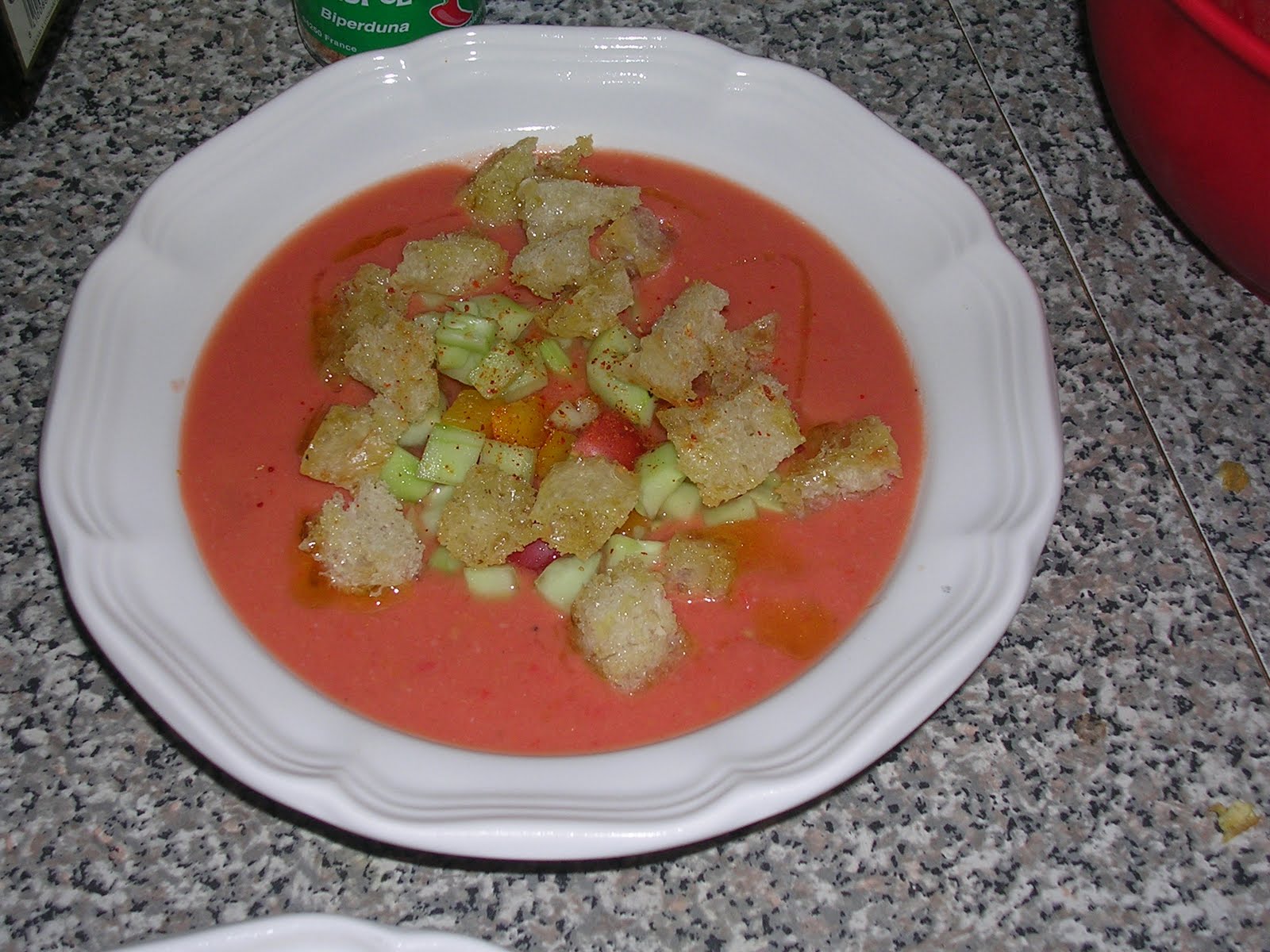
Traditional Andalusian gazpacho

I made the trek this morning to the awe-inspiring Dunwoody Farmers' Market, where I got some lovely, sweet cucumbers and a couple kinds of tomatoes from two different vendors. The tiny multi-colored heirlooms will go into pasta caprese later in the week, and the "regular" (I guess plum?) ones, which were very ripe, made me switch my meal plan around so that I could make gazpacho today.
Contrary to appearances, I don't actually love Spanish food; for one thing, I haven't cooked or eaten enough of it to judge, and for another, olives are one of the few foods I simply cannot eat in any form (except the oil), and they seem to show up in a lot of Spanish dishes. A couple summers ago, I tried making gazpacho, a Cook's Illustrated recipe (as with many popular dishes they have several versions, and I can't recall which I tried), and it was disappointing. I just didn't like the flavor or texture. I wanted to try again, knowing that there can be a wide range of gazpacho styles, so this time I turned to the Andalusian recipe in the first chapter of CI's Restaurant Favorites (it is adapted from Jaleo in D.C., where the famous José Andrés is chef).
The soup is nothing more than a slice of bread for thickener, garlic (which I just realized I forgot!), tomatoes, bell peppers (it called for green, I used yellow), cucumbers, sherry vinegar, and olive oil, pureed with enough water to make it the right consistency, then strained. I do not have a medium-mesh strainer as called for, so I tried to approximate what that would produce by using my fine-mesh strainer and adding back into the soup about half of the solids. The "garnish," which is much more substantial than I am accustomed to associating with the term, simply reprised the vegetables in small dice along with fresh garlic croutons. It was a great soup, and I'd make it again exactly as I did tonight, but I'm glad I cut back the yield to 2 servings so there were no leftovers. It's the sort of thing we wouldn't really crave, but once it's on the table, it seems right and tastes delicious. I served it with our old friend the "Spanish" tortilla, fully Americanized with Frank's sauce because I didn't feel like making Romesco, and ciabatta toasts with Manchego cheese. Which is one Spanish food I really am starting to like.
Subscribe to:
Posts (Atom)